Tiberghien, J-E. (2016) School WASH reports Four reports analyse the status of water, sanitation and hygiene in schools in Bangladesh, Nepal, India and Pakistan.
Just 71% schools worldwide have a safe water supply – as few as 54% in sub-Saharan Africa, and just 69% have safe sanitation access – as few as 53% in sub-Saharan Africa (UNICEF 2015). Correct use, maintenance, and sustainability of school water, sanitation and hygiene (WASH) services, and hygiene behaviours, remain big challenges in many countries. WaterAid has conducted research in Bangladesh, India, Nepal, and […]

Online since: 27.01.2017
Views: 4379
Downloads: 4102
Veses, O., Dinku, D., Assefa, E., Peal, A., Evans, B. (2016) SFD Report - Bahir Dar, Ethiopia SFD Promotion Initiative
Bahir Dar is a city located northwest Ethiopia with a tropical savannah climate. According to the Town Administration, the population is 318,429 people, where 85% live in the urban and 15% in the peri-urban and rural areas of the city (data from 2012). Economic activities include an expanding textile industry as well as rapidly growing agro-industries. The potential for tourism and real estate development is […]

Online since: 27.01.2017
Views: 8805
Downloads: 14790
Furlong, C. (2016) SFD Report - Santa Cruz, Bolivia SFD Promotion Initiative
Santa Cruz de la Serria Metropolitan Area (SCMA) is the second largest urban area in Bolivia. It is a major economic centre in Bolivia. There are approximately 1.9 million inhabitants in SCMA. The city is considered to be one of the fastest growing cities in the world. Santa Cruz is located in eastern Bolivia on the Pirai Riva at an altitude of 416 m above […]

Online since: 26.01.2017
Views: 5169
Downloads: 8975
White, S., et al. (2016) A Qualitative Study of Barriers to Accessing Water, Sanitation and Hygiene for Disabled People in Malawi
Globally, millions of people lack access to improved water, sanitation and hygiene (WASH). Disabled people, disadvantaged both physically and socially, are likely to be among those facing the greatest inequities in WASH access. This study explores the WASH priorities of disabled people and uses the social model of disability and the World Health Organization’s International Classification of Functioning, Disability and Health (ICF) framework to look […]

Online since: 26.01.2017
Views: 4095
Downloads: 349
Dodos, J. (2017) WASH’ Nutrition -A practical guidebook on increasing nutritional impact through integration of WASH and Nutrition programmes (in English and French)
The guidebook on how to increase nutritional impact through integration of WASH and Nutrition programmes is an operational guidebook which demonstrates the importance of both supplementing nutrition programmes with WASH activities and adapting WASH interventions to include nutritional considerations i.e. making them more nutrition-sensitive and impactful on nutrition. It has been developed to provide practitioners with usable information and tools so that they can design […]

Online since: 25.01.2017
Views: 5144
Downloads: 874
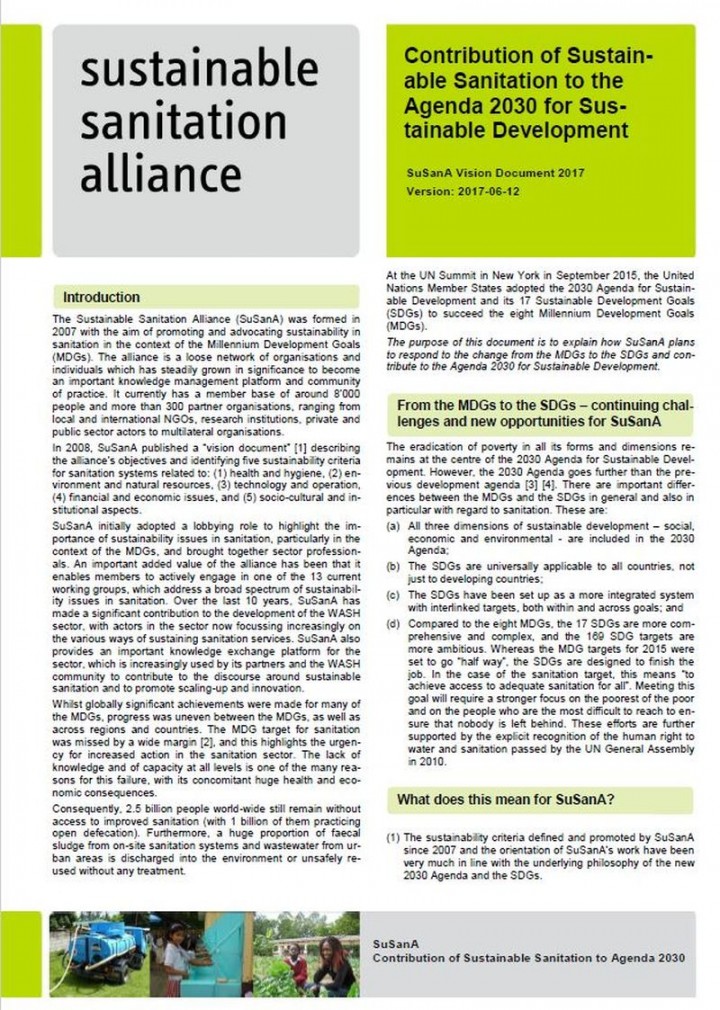
SuSanA (2017) SuSanA Vision Document 2017 Contribution of sustainable sanitation to the Agenda 2030 for sustainable development
The Sustainable Sanitation Alliance (SuSanA) was formed in 2007 with the aim of promoting and lobbying for sustainability in sanitation in the context of the Millennium Development Goals. Over the last 10 years SuSanA has made a significant contribution to sector development, with sector actors now focussing increasingly on the sustainability of sanitation services in a variety of ways. Whilst globally significant achievements were made […]
Online since: 23.01.2017
Views: 15442
Downloads: 26722
Walther, D., et al. (2016) Local and innovative waste water solution The case of Kochi - SNUSP II
This project description summarises the steps towards an energy and resource-efficient wastewater and septage management system in Kochi. It is a project coordinated by the Support to National Urban Sanitation Policy project of GIZ India.

Online since: 20.01.2017
Views: 4313
Downloads: 411
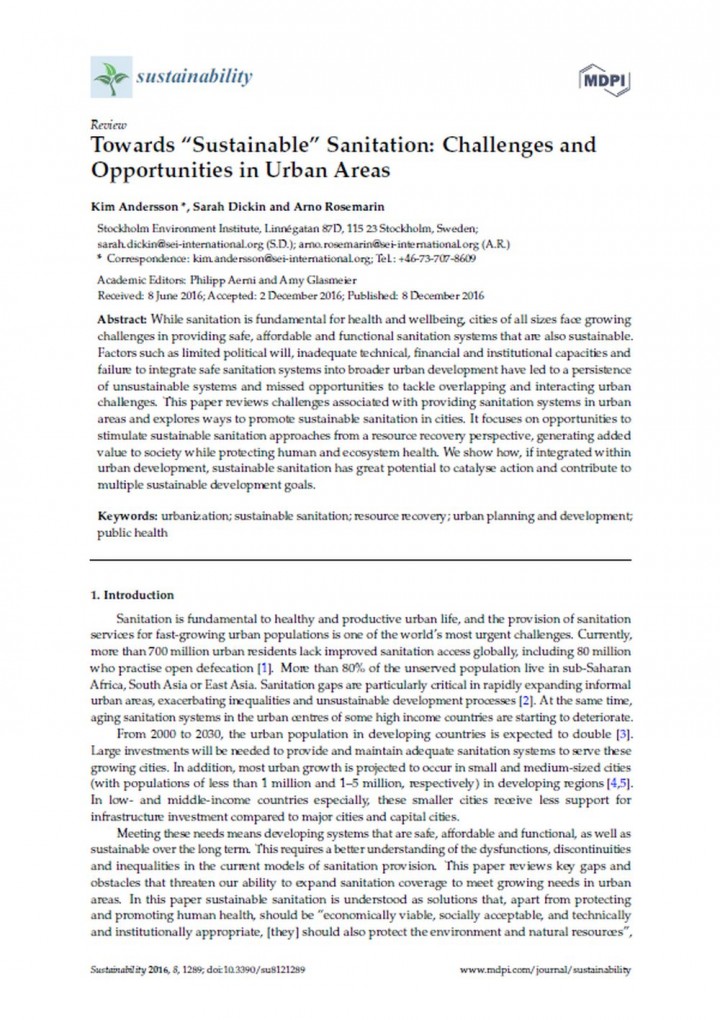
Andersson, K., Dickin, S., Rosemarin, A. (2016) Towards “Sustainable” Sanitation: Challenges and Opportunities in Urban Areas
While sanitation is fundamental for health and wellbeing, cities of all sizes face growing challenges in providing safe, affordable and functional sanitation systems that are also sustainable. Factors such as limited political will, inadequate technical, financial and institutional capacities and failure to integrate safe sanitation systems into broader urban development have led to a persistence of unsustainable systems and missed opportunities to tackle overlapping and […]
Online since: 20.01.2017
Views: 3251
Downloads: 374
Parkinson, J., Lüthi, C., Walther, D. (2014) Sanitation 21 A Planning Framework for Improving City-wide Sanitation Services
Sanitation21 is an important component of the global sanitation toolkit, which presents a planning framework based on international best practices. Initially developed in 2006, this updated version builds on recent experiences where good planning has formed an integral part of achieving improvements in urban sanitation. In the context of this document, planning is essentially about responding to real needs and making informed decisions about investments for […]

Online since: 16.01.2017
Views: 4570
Downloads: 537
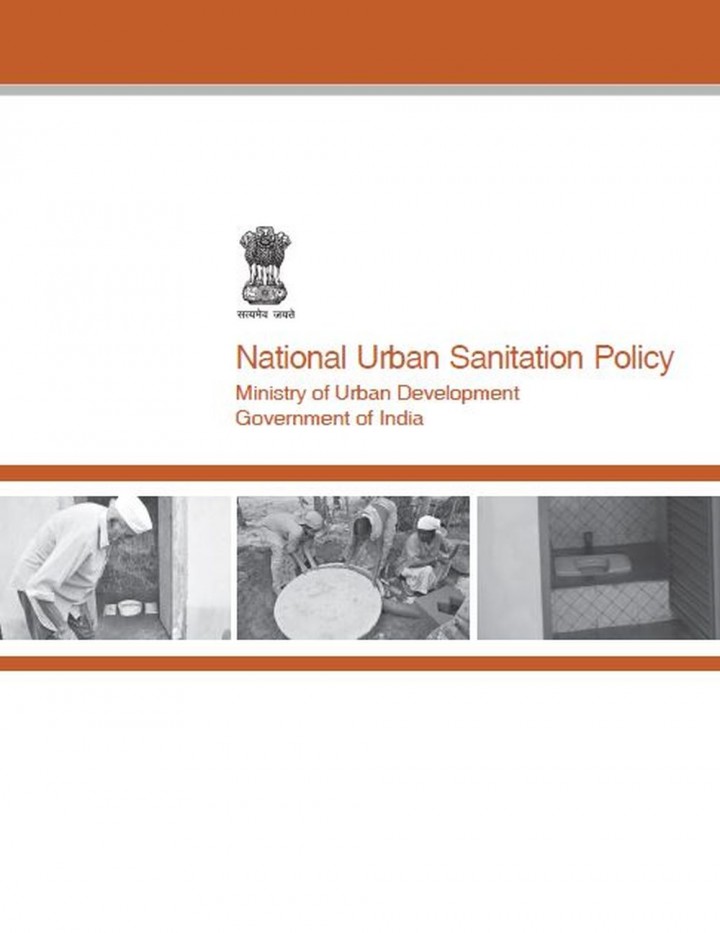
Ministry of Urban Development (Government of India) (2014) National Urban Sanitation Policy
This publication summarizes the background, vision and sanitation policy issues in India that are adressed with the National Urban Sanitation Policy by the Ministry of Urban Development. It also provides draft frameworks, e.g. for City Sanitation Plans or developing state sanitation strategies.
Online since: 16.01.2017
Views: 8117
Downloads: 13965
Walther, D. et al. (2014) Support to the National Urban Sanitation Policy (SNUSP II) Factsheet
This factsheet provides an overview of the SNUSP Project objectives, approach and achievements.

Online since: 12.01.2017
Views: 3141
Downloads: 312
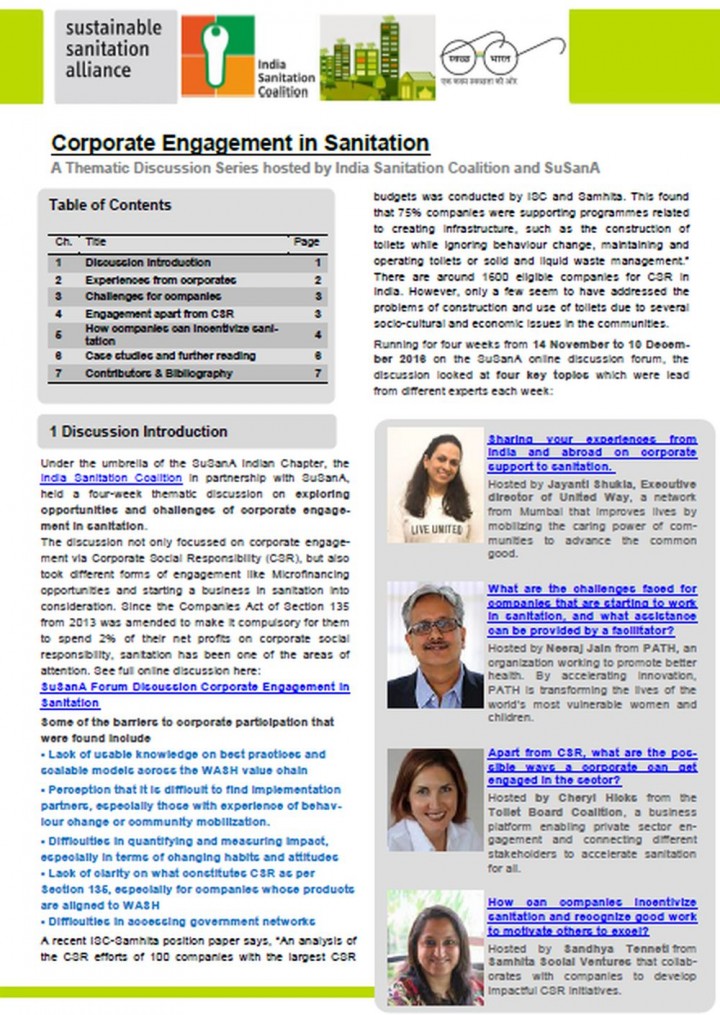
Jacob, N., von Falkenhausen, A., Bauer, M. (2017) Corporate Engagement in Sanitation Synthesis Document - SuSanA Indian Chapter online discussion
Under the umbrella of the SuSanA Indian Chapter, the India Sanitation Coalition in partnership with SuSanA, held a four-week thematic discussion on exploring opportunities and challenges of corporate engagement in sanitation. This synthesis is a summary of all topics discussed in the forum about corporate engagement. The discussion not only focussed on corporate engage-ment via Corporate Social Responsibility (CSR), but also took different forms of […]
Online since: 11.01.2017
Views: 5298
Downloads: 1097
Walther, D. et al. (2015) Introducing City Sanitation Plan - SNUSP II Trainer's Manual
Ensuring citywide sanitation is challenging and needs strategic planning as well as involvement of various actors /agencies, such as decision makers at state and city level, city engineers and technical experts in areas of urban planning, sanitation, technical infrastructure and financing. One of the main requirements in establishing a citywide sanitation system on the ground is strong institutions and technical as well as managerial capacities […]

Online since: 10.01.2017
Views: 3853
Downloads: 417
Walther, D. et al. (2016) Preparing City Sanitation Plan - SNUSP II Trainer's Manual
This training programme is a unique blend of training courses for participants coupled with additional handholding support through various mechanisms in a step-wise manner. This is a distinguishing feature from other stand-alone training programmes and ensures that the participants are themselves capacitated through the training. Handholding support leads to transfer of knowledge on the ground for achieving actual change in their respective cities. This training […]

Online since: 10.01.2017
Views: 3746
Downloads: 424
Nandan, V., Dua, S. (2014) Enabling Systems for Improved Municipal Solid Waste Management in Cities Making way for a clean and healthy India
This factsheet was published by the Support to National Urban Sanitation Policy-Project by GIZ India to give an overview of ways that this project apporaches to manage Municipal Solid Waste (MSW) in urban areas.

Online since: 10.01.2017
Views: 3451
Downloads: 409
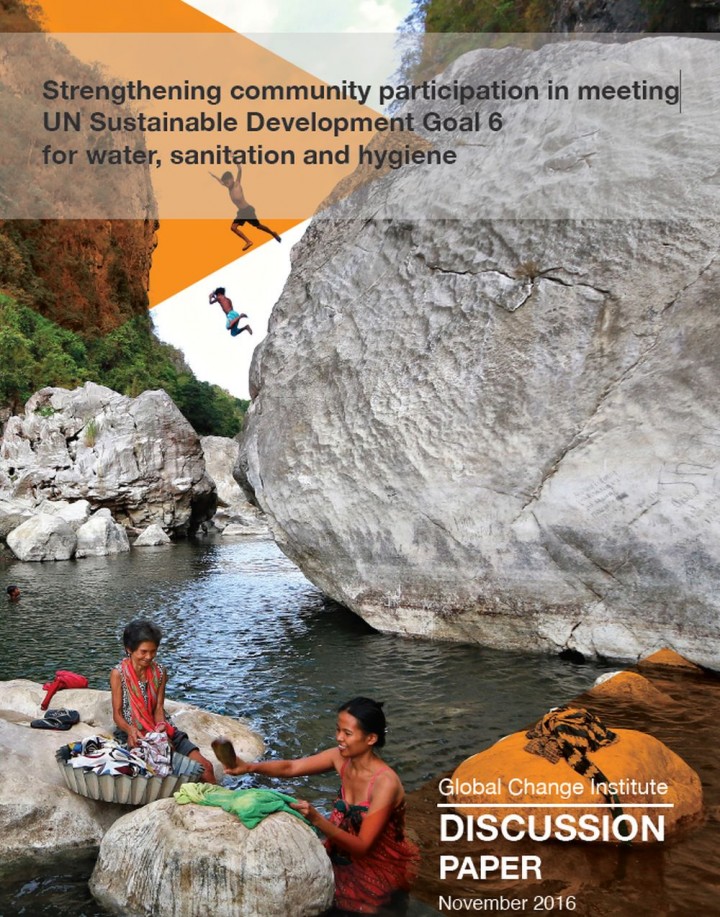
Hall, N. et al. (2016) Strengthening community participation in meeting UN Sustainable Development Goal 6 for water, sanitation and hygiene Discussion Paper No.3
Countries have much work to do to achieve the UN Sustainable Development Goals by 2030. But development projects don’t always go the way you expect. A resettlement project in Laos recently provided taps and toilets as a way to improve hygiene and health outcomes for communities. But on revisiting the resettled village, the project team was dismayed to find that the new brick toilet facilities […]
Online since: 21.12.2016
Views: 5034
Downloads: 8761
Hall, N. et al. (2016) Achieving the UN Sustainable Developement Goals for water and beyond Discussion Paper No.2
This transdisciplinary discussion paper, from 13 researchers across seven schools at The University of Queensland, considers Australia’s efforts to achieve the United Nations Sustainable Development Goals in Australia and within the broader Asia-Pacific region. It focuses particularly on those SDGs that are concerned with water, and it challenges the current steps being undertaken towards attaining the SDGs in both Australia and overseas. The recommendations identify […]

Online since: 21.12.2016
Views: 2721
Downloads: 4610
Hall, N. et al. (2016) The UN Sustainable Development Goals for water and sanitation - How should Australia respond within and beyond its borders? Discussion Paper No.1
Australia is positioned next to south-east Asia, where one billion people lack access to adequate sanitation facilities. Only half the population in the Pacific Island countries have access to such facilities, while poor hygiene and unsanitary living conditions have contributed to children in remote Australian Aboriginal communities experiencing a higher rate of common infectious diseases than in large urban communities. In 2015, the UN updated […]

Online since: 21.12.2016
Views: 3031
Downloads: 341
Stockholm International Water Institute (2016) City-wide sanitation: The role of planning Policy brief
In 2016 the World Water Week (WWW) brought together leading experts from around the world to discuss and share the latest experiences on planning urban sanitation in two sessions convened by WaterAid, UNDP-SIWI Water Governance Facility, GIZ, SuSanA, and the World Bank. This policy brief synthesises the key lessons and recommendations that grew out of that encounter, calling for more flexible and context-sensitive planning and […]

Online since: 19.12.2016
Views: 5314
Downloads: 9217
De Albuquerque, C. (2014) Realising the human rights to water and sanitation: A handbook Arabic, French, Portuguese and Spanish
A product of six years of work, the goal of the handbook is to explain the meaning and legal obligations of these rights and to translate complex technical and legal language into accessible information. Designed for a broad audiences in the Global South and North, the information should be useful to civil society sanitation advocates, human right organizations, national and local offcials, service providers, and […]
Online since: 19.12.2016
Views: 4628
Downloads: 13080